
AP AEE 2026 Syllabus, AEE Electrical Recruitment 2026 Preparation Guide – Complete Syllabus Analysis, Best Books & 45-Day Study Plan. Preparing for the AEE Electrical Recruitment 2026 Exam? This comprehensive preparation guide will help you understand the official syllabus, choose the best reference books, prepare a smart study plan, and maximize your score in the examination.
The Assistant Executive Engineer (Electrical) recruitment examination is one of the most competitive engineering exams. Candidates require a strong understanding of Electrical Engineering fundamentals along with good preparation in General Awareness, Reasoning, Quantitative Aptitude, English, and Computer Knowledge. According to the official syllabus, the technical (core) section carries the highest weightage, making it the deciding factor in selection.
AEE Electrical Recruitment 2026 Preparation Guide – Complete Syllabus Analysis, Best Books & 45-Day Study Plan. Preparing for the AEE Electrical Recruitment 2026 Exam? This comprehensive preparation guide will help you understand the official syllabus, choose the best reference books, prepare a smart study plan, and maximize your score in the examination.
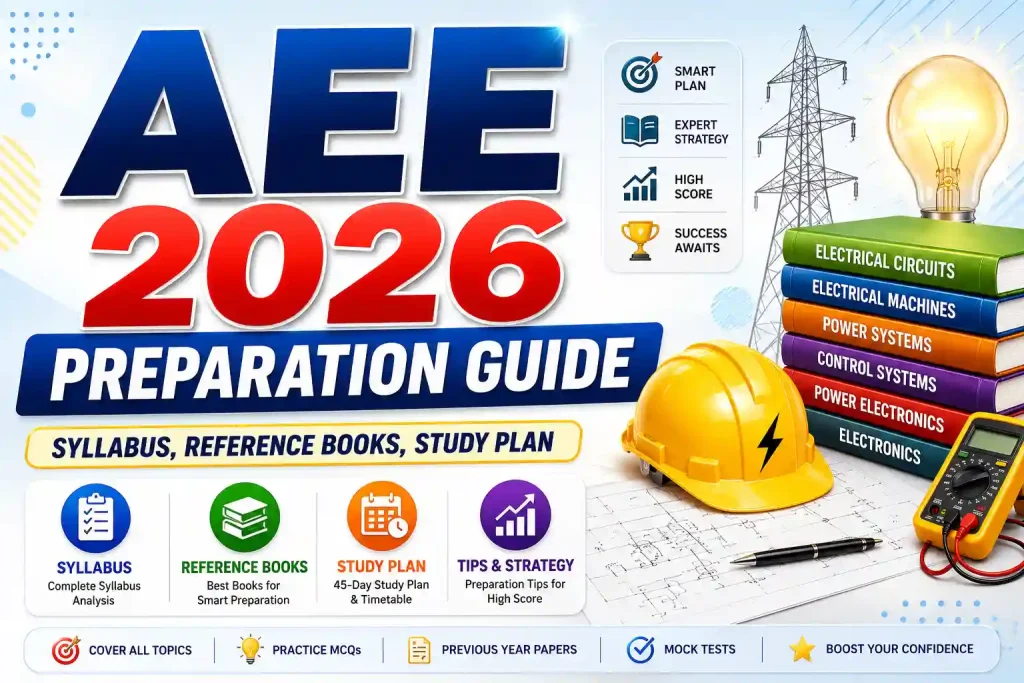
The Assistant Executive Engineer (Electrical) recruitment examination is one of the most competitive engineering exams. Candidates require a strong understanding of Electrical Engineering fundamentals along with good preparation in General Awareness, Reasoning, Quantitative Aptitude, English, and Computer Knowledge. According to the official syllabus, the technical (core) section carries the highest weightage, making it the deciding factor in selection.
AEE Electrical Exam Pattern
The examination consists of two major sections:
| Section | Marks |
|---|---|
| Core Electrical Engineering | 70 |
| General Subjects | 30 |
| Total | 100 |
General Subjects Include
- Reasoning
- General Awareness
- Quantitative Aptitude
- English Language
- Computer Knowledge
The technical section contributes nearly 70% of the total score, making it the most important area for preparation.
Detailed AEE Electrical Syllabus Analysis
The Electrical Engineering syllabus is divided into seven major subjects.
1. Electrical Circuits
This is the foundation of Electrical Engineering and one of the highest-scoring topics.
Important Topics
- KCL
- KVL
- Mesh Analysis
- Nodal Analysis
- Star-Delta Transformation
- Network Theorems
- AC Fundamentals
- Resonance
- Two-Port Networks
- Three-Phase Circuits
- Power Measurement
Expected Weightage
Approximately 10–12 questions
Best Reference Books
- Network Analysis – Van Valkenburg
- A. Sudhakar & Shyammohan
- ACE Academy Class Notes
Preparation Tips
- Master Network Theorems.
- Practice numerical problems daily.
- Learn shortcut methods for AC circuit analysis.
- Revise phasor diagrams regularly.
2. Electrical Machines
This subject carries one of the highest weightages.
Topics
- Single Phase Transformer
- Three Phase Transformer
- Auto Transformer
- DC Generators
- DC Motors
- Induction Motors
- Synchronous Machines
- Motor Starting
- Speed Control
Expected Weightage
12–15 Questions
Best Books
- P.S. Bimbhra
- Nagrath & Kothari
- Objective Electrical by Made Easy
Preparation Strategy
- Focus on equivalent circuits.
- Practice torque-speed characteristics.
- Memorize efficiency and regulation formulas.
- Understand starting methods clearly.
3. Power Systems
One of the most important and conceptual subjects.
Topics
- Generation
- Transmission
- Distribution
- Per Unit System
- Load Flow
- Fault Analysis
- Protection
- Relays
- Circuit Breakers
- System Stability
Expected Questions
10–12
Best Books
- C.L. Wadhwa
- Nagrath & Kothari
- Badri Ram (Protection)
Tips
- Practice fault calculations.
- Understand relay characteristics.
- Learn per-unit conversion thoroughly.
- Revise transmission line formulas.
4. Control Systems
Topics
- Transfer Functions
- Block Diagrams
- Signal Flow Graph
- Routh Stability
- Root Locus
- Nyquist Plot
- Bode Plot
- Compensation Techniques
Weightage
6–8 Questions
Books
- I.J. Nagrath
- Norman Nise
Tips
- Practice block diagram reduction.
- Solve stability problems daily.
- Memorize standard transfer functions.
5. Electrical Measurements
Topics
- Bridges
- Potentiometers
- PMMC Instruments
- Moving Iron Instruments
- Dynamometer Instruments
- CRO
- Digital Voltmeters
- Energy Meter
- Frequency Measurement
Books
- A.K. Sawhney
Preparation Tips
- Understand working principles.
- Practice instrument error calculations.
- Learn advantages and disadvantages of each instrument.
6. Analog & Digital Electronics
Topics
Analog
- Diodes
- BJT
- FET
- Amplifiers
- Oscillators
Digital
- Logic Gates
- Flip Flops
- Counters
- ADC
- DAC
- Microprocessor Basics
Best Books
- Sedra & Smith
- Morris Mano
Weightage
8–10 Questions
7. Power Electronics
Topics
- SCR
- TRIAC
- MOSFET
- IGBT
- Controlled Rectifiers
- Choppers
- Inverters
- AC Drives
- DC Drives
Books
- P.S. Bimbhra
- M.D. Singh
Weightage
6–8 Questions
General Subjects Preparation
Reasoning
Focus on
- Coding-Decoding
- Series
- Analogies
- Venn Diagrams
- Non-Verbal Reasoning
Book
R.S. Aggarwal
Quantitative Aptitude
Important Topics
- Simplification
- Percentage
- Ratio
- Average
- Time and Work
- Profit and Loss
Book
Fast Track Arithmetic
Rajesh Verma
English
Topics
- Grammar
- Vocabulary
- Error Detection
- Cloze Test
- Reading Comprehension
Book
SP Bakshi
General Awareness
Prepare
- Current Affairs (Last 6–8 Months)
- Indian Polity
- Economy
- Science
- Geography
- History
Book
Lucent General Knowledge
Computer Knowledge
Topics
- MS Office
- Internet
- Networking
- Windows
- Cyber Security
- Computer Fundamentals
Book
Arihant Computer Awareness
Best Reference Books for AEE Electrical
| Subject | Recommended Book |
|---|---|
| Electrical Circuits | Van Valkenburg |
| Electrical Machines | P.S. Bimbhra |
| Power Systems | C.L. Wadhwa |
| Control Systems | I.J. Nagrath |
| Measurements | A.K. Sawhney |
| Analog Electronics | Sedra & Smith |
| Digital Electronics | Morris Mano |
| Power Electronics | P.S. Bimbhra |
| Objective Questions | Made Easy Objective Electrical |
| Previous Papers | GATE + SSC JE + AE/AEE Previous Year Papers |
45-Day Preparation Plan
Days 1–10
- Electrical Circuits
- Network Theory
- AC Circuits
- Three Phase Systems
Practice
- 60 MCQs Daily
Days 11–20
- Electrical Machines
- Transformer
- DC Machines
- Induction Motors
- Synchronous Machines
Daily
- 75 MCQs
Days 21–30
- Power Systems
- Protection
- Transmission
- Distribution
- Fault Analysis
Daily
- 80 MCQs
Days 31–35
- Control Systems
- Measurements
- Analog Electronics
Days 36–40
- Digital Electronics
- Power Electronics
Days 41–45
- Complete Revision
- Formula Revision
- Previous Year Questions
- Full-Length Mock Tests
<strong>Daily Study Timetable
ity
| Time</th> | Activ |
|---|---|
| 6:00–8:00 AM | Core Subject Study |
| 9:00–11:00 AM | Numerical Problems |
| 2:00–4:00 PM | Objective Questions |
| 5:00–6:00 PM | Aptitude & Reasoning |
| 6:00–7:00 PM | English & Current Affairs |
| 8:00–9:00 PM | Formula Revision |
Preparation Tips for Success
- Complete the syllabus at least once before starting intensive revision.
- Make short notes and formula sheets for each subject.
- Solve previous year question papers to understand the exam pattern.
- Attempt at least 10–15 full-length mock tests before the exam.
- Analyze your mistakes after every mock test and revise weak topics.
- Dedicate 1–2 hours daily to General Subjects to ensure balanced preparation.
- Revise important formulas every day during the final two weeks.
Common Mistakes to Avoid
- Ignoring the General Subjects section.
- Reading multiple books for the same topic.
- Avoiding mock tests until the last week.
- Not revising formulas regularly.
- Spending too much time on already strong subjects while neglecting weaker areas.
Assistant Executive Engineer/Electrical: (Core 70 Marks)
Electric Circuits: Network graph, KCL, KVL, node and mesh analysis, star/delta transformation, electromagnetic induction; mutual induction; ac fundamentals; harmonics, transient response of DC and AC networks; sinusoidal steady state analysis, resonance, ideal current and voltage sources, Thevenin’s, Norton’s Superposition and Maximum Power Transfer theorems, two-port networks, three phase circuits, power measurement.
Electrical Machines: Single phase transformer-equivalent circuit, phasor diagram, tests, regulation and efficiency; three phase transformers – connections, Parallel operation; auto-transformer; DC machines – types, windings, generator/motor characteristics, armature reaction and commutation, starting and speed control of motors; three phase induction motors-principles, types, performance characteristics, starting and speed control; single phase induction motors; synchronous machines – performance, regulation and parallel operation of generators, motor starting, characteristics and applications.
Power Systems: Basic power generation concepts; transmission line models and performance; underground cable, string insulators; corona; distribution systems; per-unit quantities; bus impedance and admittance matrices; load flow; voltage control, power factor correction; economic operation; symmetrical components; fault analysis; principles of over-current, differential and distance protection; protection of alternator, transformer, transmission lines neutral earthing, Solid state relays and digital protection; circuit breakers; system stability concepts, swing curves and equal area criterion.
Utilization & Control Systems: Principles of feedback; transfer function; block diagrams, steady- state errors; Routh and Nyquist techniques; Bode plots; root loci, lag, lead and lead – lag compensation; Heating – resistance, induction, dielectric; Welding spot, seam and butt, Electric traction – speed-time curves, tractive effort;
Measurements: Bridges and potentiometers; PMMC, moving iron, dynamometer and induction type instruments; measurement of voltage, current, power, energy and power factor, digital voltmeters and multi meters; phase, time and frequency measurement; Q- meters; oscilloscopes;
Analog and Digital Electronics: Characteristics of diodes, BJT, FET; amplifiers – biasing, equivalent circuit and frequency response; oscillators and feedback amplifiers; Combinational and sequential logic circuits; multiplexer, Schmitt trigger, A/D and D/A converters; 8-bit microprocessor basics, architecture, programming and interfacing.
Power Electronics and Drives: Semiconductor power diodes, transistors, thyristors, triacs, GTOs, MOSFETs and IGBTs – static characteristics and principles of operation, triggering circuits, phase control rectifiers; bridge converters – fully controlled and half controlled principles of choppers and inverters basic concepts of adjustable speed dc and ac drives.
Assistant Executive Engineer/Telecom: (Core 70 Marks)
Network Analysis: Kirchoff’s Laws, RC, RL & RLC Circuits, Initial conditions, Energy, Power, Instantaneous, max, average, RMS values of alternating currents, Phaser representation, transient and steady state analysis, Total response. Network analysis using Laplace Transforms, properties of Laplace transforms.
Fourier Series: Continuous and discrete Fourier Transforms, z-transforms. Applications to signal Analysis. Convolution. Network Theorems and Applications. Two Port Parameters, Series, Parallel and Cascade connections of two port networks, Z, Y, ABCD Parameters, Network Functions, Poles and Zeros. Driving point and Transfer Functions, Image Parameters, Conventional LP, HP, BP, Band Stop Filters. Composite Filters, T, π & Lattice Networks, Attenuators and Equalizers.
Electronic Devices & Circuits: PN Junction, PNP, NPN Transistors. Biasing. Tunnel Diode, FET, UJT, SCR Characteristics, Various CB, CE,CC transistor Amplifiers Analysis & Performance. RC coupled and push pull amplifiers, compensation techniques, Feedback, Negative feedback, oscillator Circuits, Phase Shift Oscillator.
Digital Circuits: Wave Shaping, multi-vibrators, Sweep Generators, Counters, logic Gates and Circuits, Number Systems, Codes, Error Detection and Correction. Sequential Circuits, Integrated Circuits OP Amps-Applications, IC Comparator Circuits, A/D, D/A Converters,
Linear Control System: Open loop, closed loop system, Signal Flow Graphs, Stability Routh-Hurwitz and Nyquist Criterion, Bode plots, Gain-phase Margin. Lead-Lag compensation Techniques.
Transmission Lines & Antennas: Transmission line equation, Primary and Secondary Parameters, Propagation constants, Open and Short Circuited Lines, Standing Waves, Reflection Coefficient, VSWR, Line as Circuit element, Impedance Matching.
Maxwell’s equations and Field Theory: Various Laws & Theorems in Electromagnetism, Plane Waves, Boundary Conditions, Concept of Radiation, Half wave Dipole, Antenna Arrays, Communication Antennas-performance Characteristics.
Wave guides and Components: Reciprocal & non-Reciprocal Wave guide components, Couplers, Tees, Microwave Sources, Microwave Communication, Link Design.
Basics of Micro Processors & Micro Controllers: Architecture and Assemblers. memory Devices.
Communication systems: Modulation, All types of Modulation techniques, SNR, Analog & Digital Communication techniques, multiplexes, Demodulators, Radio Receivers & Transmitters Characteristics & Basics of Fibre Optics Communication and Satellite Communication Systems.
c) Assistant Executive Engineer/Civil: (Core 70 Marks):
Strength of Materials: Simple stresses and strains. Hooke’s law. Stress-strain curve for mild steel, elastic constants, compound bars, temperature stresses, strain energy, resilience, impact loading, SFD and BMD for simple cantilever and overhanging beams. Centre of gravity and moment of inertia, bending and shear stress distributions. Theory of pure torsion, helical spring, thin and thick cylinders, analysis of trusses by method of joints and method of sections, combined direct and bending stresses, column and struts, deflection of beams-double integration, moment area and conjugate beam methods.
Reinforced Concrete: Basic reinforcing materials, tests on cement and aggregates, Structural concrete and its grades, workability tests and concrete mix design. Singly and doubly reinforced beams, working stress design of rectangular and flanged beams shear bond, development length and torsion in beams, one-way and two-way slabs, axially and eccentrically loaded columns, isolated and combined footings. Basic concepts of limit state design and its applications to the design of beams, slabs and columns.
Soil Mechanics: Physical properties of soils, classification and identification, permeability, capillarity, seepage, compaction, shear strength, Earth pressure, slope stability.
Steel Structures: Grades of steels, design of simple and compound beams, riveted and welded joints, riveted and welded connections eccentric framed and seated, simple and compound columns, slab and gusseted bases, grillage foundations, roof trusses, plastic analysis-plastic bending of beams, shape factor, plastic analysis theorems, and analysis of fixed, propped cantilever beams by static and kinematic methods.
Fluid Mechanics & Machinery: Fluid properties, pressure measurements, manometers, forces on plane and curved surfaces, center of pressure, principle of buoyancy, stability of floating and submerged bodies, meta centre, Kinematics of fluid flow, equation of continuity. Euler’s and Bernoulli’s equations, Impulse-momentum, flow measuring devices-orifices and mouth pieces, notches and weirs, flow through pipes, open channel flow, impact of jets-stationery and moving vanes (flat and curved), radial vanes, hydraulic turbines, pumps and machinery.
Foundation Engineering: Stress distribution in soils, bearing capacity, settlement analysis, pile foundation, Coffer dams, Caissons, Dewatering, Bracing for excavations, site investigations, New mark charts, Machine foundation.
-
Strength of Materials:
Simple stresses and strains Hooke’s law, elastic constants, stress strain curve of mild steel bars of uniform strength, compound bars, temperature stresses, stresses on oblique planes – principal stresses and strains, Mohr’s stress circle, shear force and bending moment diagrams for beams, bending and shear stresses in beams, deflections of beams, columns and struts, strain energy, torsion of circular shafts and springs.
- Fluid Mechanics and Machinery:
Basic fluid properties, fluid static – pressure measurements, buoyancy and flotation, fluid kinematics, fluid dynamics – Euler’s Bernoulli’s and Impulse momentum equations, laminar and turbulent flows, flow through pipes and losses in pipes, bends, boundary layer theory, compressible fluid flow, impact of jets, Hydraulic turbines and pumps, Ram, Accumulator and intensifier.
- Material science and metallurgy:
Structure and properties of engineering materials, bonding in solids, imperfections in crystals and metals, structure of alloys, manufacture of iron and steel, heat treatment, alloy steels, principles of powder metallurgy.
- Theory of Machines:
Displacement, velocity and acceleration analysis of plane mechanisms, dynamic analysis of slider – crank mechanism, gear trains, flywheels.
- Vibrations:
Free and forced vibrations, effect of damping, resonance, vibration isolation, critical speeds of shafts.
- Design of Machine elements:
Design for static and dynamic loading failure theories, fatigue strength, S-N diagram, design of joints, shafts, bearings, gears, brakes, clutches, screws, springs, cranks, piston, gyroscopes, balancing and governors.
- Heat Transfer:
Various modes of heat transfer, fins, heat exchangers, LMTD & NTU methods, unsteady state heat conduction, dimensionless parameters, free and forced convective heat transfer, thermal boundary layer, heat transfer in flow-over flat plates and through pipes, effect of turbulence, radiative heat transfer, shape factors, network analysis, condensation and boiling.
- Thermodynamics:
Zeroth, first and second laws of thermodynamics, thermodynamics systems and processes, Carnot cycle, Air-standard cycles, irreversibility and availability, properties of pure substances, psychometry, Refrigeration and Air conditioning, working principles and their applications.
- Applied Thermodynamics:
classification of compressors and its working principles, Classification of I.C. Engines and its working principles, performances, Design considerations of combustion chambers for C.I. & S.L Engines, knocking, rating of fuels, lubrications, Ignition systems.
- Turbo Machines:
Working principles of gas turbines, steam turbines, Rankine’s cycle. Modified Rankine’s cycle, jet propulsion and nozzles.
- Metal cutting and machine tools:
Mechanics of machining, single and multi-point cutting tools, tool geometry, tool life wear, cutting force analysis, micro finishing machines – EDM, ECM and USM, NC machines, jigs and fixtures. Standards of measurements, limits, fits, tolerances, linear and angular measurements, comparators, lathes, drilling, shaping, planning, milling, gear cutting. Broaching and grinding machines.
- Foundry, Welding and Forging:
Design of patterns moulds and cores, solidification, design consideration of runner, riser and gate. Physics of welding, types of welding and their principles, brazing, soldering, adhesive bonding, Fundamental of hot and cold working processes, forging, rolling, extrusion, drawing, shearing and bending.
- Production and operation management:
Plant layout, material handling, production planning and control, materials, management and work studies, inspections, quality control, cost analysis, operation research, basic concepts of CAD/CAM, inventory control.
-
Basics of Circuits and Measurement Systems:
Kirchoff’s laws, mesh and nodal Analysis, Circuit theorems. One-port and two-port Network Function. Static and dynamic characteristics of Measurement Systems. Error and uncertainty analysis. Statistical analysis of data and curve fitting.
- Transducers, Mechanical Measurement and Industrial Instrumentation:
Resistive, Capacitive, Inductive and piezoelectric transducers and their signal conditioning. Measurement of displacement, velocity and acceleration (translational and rotational), force, torque, vibration and shock.
Measurement of pressure, flow, temperature and liquid level. Measurement of pH, conductivity, viscosity and humidity.</p>
- Analog Electronics:
Characteristics of diode, BJT, JFET and MOSFET. Diode circuits. Transistors at low and high frequencies, Amplifiers, single and multi-stage. Feedback amplifiers. Operational amplifiers, characteristics and circuit configurations, Instrumentation amplifier. Precision rectifier. V-to-I and I-to-V converter. Op-Amp based active filters. Oscillators and signal generators.
- Digital Electronics:
Combinational logic circuits, minimization of Boolean functions. IC families, TTL, MOS and CMOS. Arithmetic circuits, Comparators, Schmitt trigger, timers and mono-stable multi vibrator. Sequential circuits, flip-flops, counters , shift registers, Multiplexer, S/H circuit, Analog-to-Digital and Digital-to-Analog converters. Basics of number system. Microprocessor applications, memory and input-output interfacing. Microcontrollers.
- Signals, Systems and Communications:
Periodic and aperiodic signals. Impulse response, transfer function and frequency response of first and second order systems. Convolution, correlation and characteristics of linear time invariant systems. Discrete time system, impulse and frequency response. Pulse transfer function. IIR and FIR filters. Amplitude and frequency modulation and demodulation. Sampling theorem, pulse code modulation. Frequency and time division multiplexing. Amplitude shift keying, frequency shift keying and pulse shift keying for digital modulation.
- Electrical and Electronic Measurements:
Bridges and potentiometers, measurement of R, L and C. Measurements of voltage, current, power, power factor and energy. A.C & D.C current probes. Extension of instrument ranges. Q-meter and waveform analyzer. Digital voltmeter and multi-meter. Time, phase and frequency measurements. Cathode ray oscilloscope. Serial and parallel communication. Shielding and grounding.
- Control Systems and Process Control:
Feedback principles. Signal flow graphs. Transient Response, steady-state-errors. Routh and Nyquist criteria. Bode plot, root loci. Time delay systems. Phase and gain margin. State space representation of systems. Mechanical, hydraulic and pneumatic system components. Synchro pair, servo and step motors. On-off, cascade, P, P-I, P-I-D, feed forward and derivative controller, Fuzzy controllers.
- Analytical, Optical Instrumentation:
Mass spectrometry, UV, visible and IR spectrometry, X-ray and nuclear radiation measurements. Optical sources and detectors, LED, laser, Photo-diode, photo- resistor and their characteristics. Interferometers, applications in metrology. Basics of fiber optics.
Common Syllabus for all exams
(i) Reasoning and General Intelligence: Questions of both verbal and non-verbal type. These will include questions on Semantic Analogy, Symbolic operations, Symbolic/Number Analogy, Trends, Figural Analogy, Space Orientation, Semantic Classification, Venn Diagrams, Symbolic/ Number Classification, Drawing inferences, Figural Classification, Punched hole/ pattern-folding & unfolding, Semantic Series, Figural Pattern-folding and completion, Number Series, Embedded figures, Figural Series, Critical Thinking, Problem Solving, Emotional Intelligence, Word Building, Social Intelligence, Coding and de- coding, Numerical operations, Other sub- topics, if any.
(ii) General Awareness: Questions are designed to test the candidates‟ general awareness of the environment around them and its application to society. Questions are also designed to test knowledge of current events and of such matters of everyday observation and experience in their scientific aspect as may be expected of an educated person. The test will also include questions relating to India and its neighboring countries especially pertaining to History, Culture, Geography, Economic Scene, General policy and scientific research.
(iii) Quantitative Aptitude: The questions will be designed to test the ability of appropriate use of numbers and number sense of the candidate. The scope of the test will be the computation of whole numbers, decimals and fractions and relationships between numbers. It will test sense of order among numbers, ability to translate from one name to another, sense or order of magnitude, estimation or prediction of the outcome of computation, selection of an appropriate operation for the solution of real-life problems and knowledge of alternative computation procedures to find answers. The questions would also be based on arithmetical concepts and relationship between numbers and not on complicated arithmetical computation (The standard of the questions will be of 10+2 level).
(iv) English Language and Comprehension: Vocabulary, grammar, sentence structure, synonyms, antonyms and their correct usage; Spot the Error, fill in the Blanks, Synonyms/ Homonyms, Antonyms, Spellings/ Detecting mis-spelt words, Idioms & Phrases, one word substitution, Improvement of Sentences, Active/ Passive Voice of Verbs, Conversion into Direct/ Indirect narration, Shuffling of Sentence parts, Shuffling of Sentences in a passage, Cloze Passage, Comprehension Passage. To test comprehension, two or more paragraphs will be given and questions based on those will be asked. At least one paragraph should be a simple one based on a book or a story and the other paragraph should be based on current affairs editorial or a report.
(v) Computer Knowledge/Proficiency: Computer Basics: Organization of a computer, Central Processing Unit (CPU), input/ output devices, computer memory, memory organization, back- up devices, PORTs, Windows Explorer, Keyboard shortcuts. Software: Windows Operating system including basics of Microsoft Office like MS word, MS Excel and Power Point etc.. Working with Internet and e-mails: Web Browsing & Searching, Downloading & Uploading, Managing an E-mail Account, e-Banking. Basics of networking and cyber security: Networking devices and protocols, Network and information security threats (like hacking, virus, worms, Trojan etc.) and preventive measures.